Hanopen 2
Costs
| Item | Amount |
|---|---|
| Single Tournament | $35.00 |
| Both Tournaments | $60.00 |
Division Entry Fees
| Division | Entry Fee |
|---|---|
| Longsword | $0.00 |
| Rapier | $0.00 |
Rules
Summary
Hanopen August will be happening August 23rd, 9 AM to 6:30 PM, with free sparring time afterwards. It will be two tournaments -- longsword and rapier, from 9-1:30 and 2-6:30, respectively -- and will cost 35 dollars for one and 60 for both. They will have a cap of 24.
If you judge, we'll pay you 60 dollars per event. (Assuming we're reasonably close to the tournament caps, of course. The vast majority of the budget is judge funding.) There's also a grocery store across the street, plus numerous quality restaurants a short walk away.
Format
Three rounds of snake-seeded 4v4 half-pool Swiss, first round all one tier and the second and third rounds each being split into three tiers of 8. Then, with the seeding following the third round of pools, all fencers will advance to a full snake-seeded double elimination bracket.
Seeding will be done initially by HEMA rating, slightly adjusted as necessary to reduce the number of people fencing their clubmates. After the first round, seeding will be done cumulatively through spooky math, which will allow for mobility between tiers with particularly strong or weak performances. (For example, if you get put into the middle tier after round 1, you could win four matches in a row and almost certainly get moved up to the top tier in round 2.)
This guarantees the following:
- Twelve pool matches for each fencer then at least two elimination matches, giving fourteen rated matches at minimum.
- Every round, you will fence at least one person adjacent to you in the rankings.
- Each fencer in a given tier fences the same average ranking of opponent. (i.e. seed 1 and seed 8 will have the same average opponent difficulty)
- Each round, you will fence more and more evenly matched opponents.
This should also be very good for rating farming.
Equipment Requirements
All Weapons
Blade Requirements
- All weapons must be in reasonable condition.
- There must not be significant burrs.
- There must not be too much rust.
- They must not be significantly bent or twisted.
- The tip of the weapon must not be a material that would cause the tip to be “sticky”, especially on a mask. This primarily extends to rubber tips but we reserve the right to force a tip change and we will have bullets available as replacements if necessary.
Gear Requirements
- Head
- Newton-rated mask
- Rigid back of head protection
- Rigid gorget
- Torso
- Padded, newton-rated HEMA jacket.
- RECOMMENDED: chest protector
- You have ribs. Yes, you.
- Arms/hands
- Rigid elbow protection (both arms, always)
- Rigid forearm protection (both arms, always)
- Legs
- Rigid shin protection (both legs, always)
- Rigid knee protection (both legs, always)
- RECOMMENDED: rigid side of knee protection.
- WE WILL MANDATE THIS EVENTUALLY, YOU HAVE BEEN WARNED
- RECOMMENDED: newton-rated pants
- Groin
- RECOMMENDED: rigid cup, regardless of anatomy.
- You have nerves there. Yes, you.
- RECOMMENDED: rigid cup, regardless of anatomy.
- Overall
- Gear must not be visibly moldy, filthy, or excessively smelly.
- There must be no exposed skin.
Longsword
Blade Requirements
- Must be a purpose-built longsword feder, or other hema-safe two-handed sword of equal or lesser length.
- Must flex at or below 37 pounds.
- Must have a substantially enlarged tip, with material added if necessary.
- Must have some form of guard (tsuba, nagle, renaissance, rings, crossguard, etc)
- Guard and schilt, if applicable, must be deemed “safe”
- Basically nothing egregious or spiky. Regenyei tulip hilts come to mind.
- Must be at most 42 inches long in the blade and must weigh between 2.5 and 4.25 pounds.
- Grip/pommel must be at most 15 inches long.
- Must be straight or, at most, slightly curved.
Gear Requirements
- Arms/hands
- Longsword-rated gloves.
- NOT RED DRAGONS.
- COME ON, IT’S BEEN A DECADE, STOP
- Longsword-rated gloves.
Rapier
Blade Requirements
- Must be a purpose-built hema-safe rapier.
- We know a rapier when we see one, don’t try to bring a dueling saber or sidesword.
- Meyer rapier people, you’re on thin ice.
- Blade width must be at or below one inch.
- Blade must not be triangular.
- Must flex at or below 25 pounds.
- Must have a substantially enlarged tip, with material added if necessary.
- Must have some form of guard (swept, sidesword, bell, etc)
- Must be at most 45 inches long in the blade and must weigh between 2.5 and 4.25 pounds.
- Must have an explicitly one-handed grip.
- Must be straight.
Gear Requirements
- Sword hand
- Any rapier glove.
- Olympic fencing gloves allowed but strongly discouraged.
- Any rapier glove.
- Off hand
- Any rapier glove.
- RECOMMENDED: Any longsword glove.
- Any rapier glove.
Link to original# Our MotivationJudging error is universally hated. As such, reducing its impact and how often it occurs is of significant importance. The vast majority of judging error comes from doubles, where two actions (each of which may or may not be quality) occur at the same time. Judging error in clean hits, either missing hits that were quality, calling hits that didn’t exist or weren’t quality, or mislabeling hits, is both far less common and borderline unsolvable. To reduce the occurrence of judging errors via the ruleset, it is thus beneficial to reduce the number of doubles. While one cannot reduce the number of accidental doubles or unintentional doubles, it is possible to reduce the number of purposeful doubles by offering a superior alternative, which for most tournaments (especially those in Europe) is the afterblow. We have attempted, with this ruleset, to give attempting a parry and then an afterblow a higher expected value than accepting a double. To reduce the impact of judging errors when they do occur in a double or potential double, it is thus beneficial to both reduce the overall impact of a double or overall messy exchange (without reducing impact so much that it becomes beneficial to double to effectively wash a non-beneficial exchange) and ensure that, in general, the action which is more likely to be seen wins a double. Finally, the judge criteria should be as non-detrimental as possible. All judging quality questions in the case of a double must be as clear as possible both in the moment and in recollection (for example, “did one blow control the hands or arms of the opponent” is not easily judgable). All judging quality questions in the case of a double must also not incentivize dangerous actions (for example, “did one blow hit much harder than the other” is not safe). And lastly, all judging quality questions in the case of a double should not be exploitable (for example, “did one blow land to the head while the other did not” is famously exploitable). We believe that we have succeeded in the first two, and somewhat succeeded in the third. # What Is Not Our MotivationThis ruleset does not in any manner, shape, or form attempt to encourage what we view as “artful fencing” or “martial fencing.” No decisions were made based on those criteria. We do not believe that it is productive to try to create a ruleset that incentivizes “artfulness” or “martiality”.# Point System * 5 points: clean hit to a deep target * cut/thrust/slice to head * thrust to torso * dominance in grapple * 3 points: clean hit to shallow target * all other clean actions not worth 5 or 2 points * 2 points: clean hit to legs * cut/thrust/slice to legs * 2 points: double with priority * 0 points: true doubleIllegal actions (any illegal action invalidates any action taken by the penalized fencer, and is added to whatever blow the non-penalized fencer either landed or was forced to pull) All penalties are assigned at the judges’ discretion.* Technical Foul: 2 points to the opponent * Exposing the back of head, or hitting it with culpability * Attacking after the hold * Generic unsafe action (anything that would make the opponent stop fencing) * Yellow Card: 5 points to the opponent * Significant excessive force * Repeated technical fouls * Substantially unsafe actions (reckless closing, leaping attacks, etc) * Red Card: Immediate loss, full points to the opponent * Intentional illegal action * Repeated yellow cards * Severely unsafe and dangerous actions (throws, joint manipulations, etc) * Harming another fencer with significant culpability * Poor behavior, unsportsmanlike conduct * Black Card: Out of the tournament, potentially banned from returning and/or told to leave * Intentional or repeated red cards * Trying to harm another fencer, or successfully harming them with full culpability * Appallingly unsafe and dangerous actions (pommel/guard strikes, punching, etc) * Severely poor behavior, extremely unsportsmanlike conduct * Actual criminal activityIf multiple fencers are penalized simultaneously with technical fouls or yellow cards then the point punishments are done subtractively. So if one fencer gets a technical foul while the other gets a yellow card, the fencer who committed the technical foul gets 3 points. In the case of a clean hit, the winning fencer receives the points for the hit. If the clean hit strikes two targets simultaneously, the higher-value target is taken. If the clean hit clearly strikes one target and then, by bouncing, glancing, or pressing, strikes a second, only the first target is taken. In the case of an afterblow (where the second hit lands in the tempo immediately following the first), the points of each blow are subtracted from the other. The first blow has a minimum of one, the second has a minimum of zero. Afterblows are also held to a far stricter standard of force, meaning that the threshold for excessive force for an afterblow is lower than for an initial hit. If the attack is dubiously an afterblow, be it potentially a double or potentially out of time, it is considered to be an afterblow. Only clear doubles and clear two-tempo actions, including both feints and actions requiring multiple steps, are not afterblows. If the arm must substantially pull back before extending again, this is out of time and not an afterblow. If a fencer lands both a double and an afterblow, then only the double is scored.
| Scores are: (fencer one, fencer two) | Fencer Two (hits second) | |||
|---|---|---|---|---|
| 5 point target | 3 point target | 2 point target | ||
| Fencer One (hits first) | 5 point target | (1,0) | (2,0) | (3,0) |
| 3 point target | (1,2) | (1,0) | (1,0) | |
| 2 point target | (1,3) | (1,1) | (1,0) | |
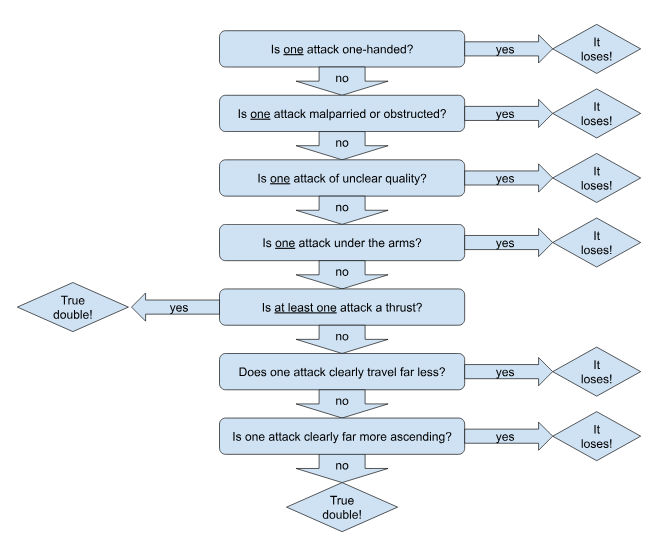 The only issue we have encountered thus far with this ruleset is forgetting the flowchart. As such, when judging, it is advisable to have the flowchart printed out.# # ResultsIn experimentation, where judge calls were corrected by the fencers, the average judging error impact was calculated.If the fencers strongly disagreed with the judge’s call, then the error was logged as having the impact of the point differential with what the fencers believed was the correct call. So if the call had a 1-0 score, but the correct call would have been 0-3, that is a four point differential. Similarly, if the call had a 2-1 score but the correct call would have been 2-0, that is a one point differential. If the fencers were unsure, then all potential differentials for all potentially correct calls were weighted evenly and averaged together. So if the call had a 2-0 score but the fencers were unsure whether it was a 2-0, a 3-0, or a 0-3, then the differential would be the average of 0, 1, and 5, and thus would be 2. “Unjudgable” incorrect calls – specifically calls where all vision of an action was blocked due to fencer rotation and actions which struck the grip of the longsword but were called as hand hits – were thrown out. The average point differential from an incorrect call was approximately 1.8, with a standard deviation of approximately 0.4. This is due to over three-quarters of incorrect calls having a one point differential, with the most common errors being between 2-0 doubles and 3-0 clean shallow hits, 2-0 doubles and 1-0 equal-target afterblows, and 0-2 doubles and 1-2 shallow-deep afterblows. This is, in our opinion, a very good average impact for judge error, as one clean deep hit is worth more than two and a half average judge errors and a single double is worth more than one average judge error.However, it must be noted that this judging error average impact was computed from the errors made by a single judge over a series of too-few individual matches including too-few distinct fencers. As such, it must be taken with a grain of salt until more testing is done.
Fencing Rules to Reduce The Impact and Occurrence of Judging Error (Rapier)
Our Motivation
Judging error is universally hated. As such, reducing its impact and how often it occurs is of significant importance. The vast majority of judging error comes from doubles, where two actions (each of which may or may not be quality) occur at the same time. Judging error in clean hits, either missing hits that were quality, calling hits that didn’t exist or weren’t quality, or mislabeling hits, is both far less common and borderline unsolvable.
To reduce the occurrence of judging errors via the ruleset, it is thus beneficial to reduce the number of doubles. While one cannot reduce the number of accidental doubles or unintentional doubles, it is possible to reduce the number of purposeful doubles by offering a superior alternative, which for most tournaments (especially those in Europe) is the afterblow. We have attempted, with this ruleset, to give attempting a parry and then an afterblow a higher expected value than accepting a double.
To reduce the impact of judging errors when they do occur in a double or potential double, it is thus beneficial to both reduce the overall impact of a double or overall messy exchange (without reducing impact so much that it becomes beneficial to double to effectively wash a non-beneficial exchange) and ensure that, in general, the action which is more likely to be seen wins a double.
Finally, the judge criteria should be as non-detrimental as possible. All judging quality questions in the case of a double must be as clear as possible both in the moment and in recollection (for example, “was one blow more in the center line” is not easily judgable). All judging quality questions in the case of a double must also not incentivize dangerous actions (for example, “did one cut hit much harder than the other” is not safe). And lastly, all judging quality questions in the case of a double should not be exploitable (for example, “did one attack begin before the other” is famously exploitable if one includes cuts to the legs). We believe that we have succeeded in the first two, and somewhat succeeded in the third.
What Is Not Our Motivation
This ruleset does not attempt to encourage what we view as “artful fencing” or “martial fencing” with the exception of preferring thrusts to (far more visible) cuts. We do not believe that it is productive to try to create a ruleset that solely incentivizes “artfulness” or “martiality”.
Point System
- 5 points: clean thrust to a deep target (or dominance in grapple)
- thrust to head
- thrust to torso or sword arm
- 4 points: clean cut to deep target:
- cut to head/shoulder
- cut to sword arm (assume cuts land to arm if unclear)
- 3 points: clean hit to shallow target
- thrust to legs
- thrust or cut to sword hand
- thrust to non-sword arm or hand (assume thrusts land to torso if unclear)
- cut to legs
- 2 points: cut to poor target
- cut to torso
- cut to non-sword arm or hand
- 2 points: double with priority
- 0 points: true double
Illegal actions (any illegal action invalidates any action taken by the penalized fencer, and is added to whatever blow the non-penalized fencer either landed or was forced to pull)
All penalties are assigned at the judges’ discretion.
- Technical Foul: 2 points to the opponent
- Grabbing the blade (exception to the rule, see below)
- Blocking a cut with the non-sword hand
- Exposing the back of head, or hitting it with culpability
- Attacking after the hold
- Generic unsafe action (anything that would make the opponent stop fencing)
- Yellow Card: 5 points to the opponent
- Significant excessive force
- Repeated technical fouls
- Substantially unsafe actions (reckless closing, leaping attacks, etc)
- Red Card: Immediate loss, full points to the opponent
- Intentional illegal action
- Repeated yellow cards
- Severely unsafe and dangerous actions (throws, joint manipulations, etc)
- Harming another fencer with significant culpability
- Poor behavior, unsportsmanlike conduct
- Black Card: Out of the tournament, potentially banned from returning and/or told to leave
- Intentional or repeated red cards
- Trying to harm another fencer, or successfully harming them with full culpability
- Appallingly unsafe and dangerous actions (pommel/guard strikes, punching, etc)
- Severely poor behavior, extremely unsportsmanlike conduct
- Actual criminal activity
An observed grabbing of the blade will count as a cut to the non-sword hand and, being illegal, will also invalidate any other scoring actions landed by that fencer. As such, a blade grab at any point will result in a clean cut against the grabber (to a poor target, so 2 points), with the highest-value blow being scored. (So if the grab happens after a clean cut to a deep target, the fencer will receive four points.) This is the only technical foul which counts as a hit and not plus 2 points.
Interposing the non-sword arm or hand in front of a cut is an illegal action, as it is unsafe. Doing so will invalidate any other scoring actions landed by the fencer who interposes their hand in front of a cut. Landing a strong cut to the non-sword hand is also penalizable at the judges’ discretion as an unsafe action and/or excessive force. If multiple fencers are penalized simultaneously with technical fouls or yellow cards then the point punishments are done subtractively. So if one fencer gets a technical foul while the other gets a yellow card, the fencer who committed the technical foul gets 3 points.
In the case of a clean hit, the winning fencer receives the points for the hit. If the clean hit strikes two targets simultaneously, the higher-value target is taken. If the clean hit clearly strikes one target and then, by bouncing, glancing, or pressing, strikes a second, only the first target is taken.
In the case of an afterblow (where the second hit lands in the tempo immediately following the first), the points of each blow are subtracted from the other. The first blow has a minimum of one, the second has a minimum of zero. Afterblows are also held to a far stricter standard of force, meaning that the threshold for excessive force for an afterblow is lower than for an initial hit. If the attack is dubiously an afterblow, be it potentially a double or potentially out of time, it is considered to be an afterblow. Only clear doubles and clear two-tempo actions, including both feints and actions requiring multiple steps, are not afterblows. If the arm must substantially pull back before extending again, this is out of time and not an afterblow. If a fencer lands both a double and an afterblow, then only the double is scored.
| Scores are: (fencer one, fencer two) |
Fencer Two (hits second) | ||||
|---|---|---|---|---|---|
| 5 point target | 4 point target | 3 point target | 2 point target | ||
| Fencer One (hits first) |
5 point target | (1,0) | (1,0) | (2,0) | (3,0) |
| 4 point target | (1,1) | (1,0) | (1,0) | (2,0) | |
| 3 point target | (1,2) | (1,1) | (1,0) | (1,0) | |
| 2 point target | (1,3) | (1,2) | (1,1) | (1,0) | |
Cut quality involves the following criteria:
- There is “sufficient” travel and/or rotation to form a well-structured cut to that target, by judges’ discretion. This will be around ninety degrees of travel arc, though well-formed cuts which land solidly may be judged as quality (again by judges’ discretion).
- The cut does not pass through or impact the guard or the strong before landing.
- The cut does not strike with just the tip.
- The cut strikes reasonably perpendicularly to the target (i.e. not glancing).
Cuts with questionable quality under these criteria should be considered quality if they strike cleanly or as an afterblow, but they lose doubles as seen below.
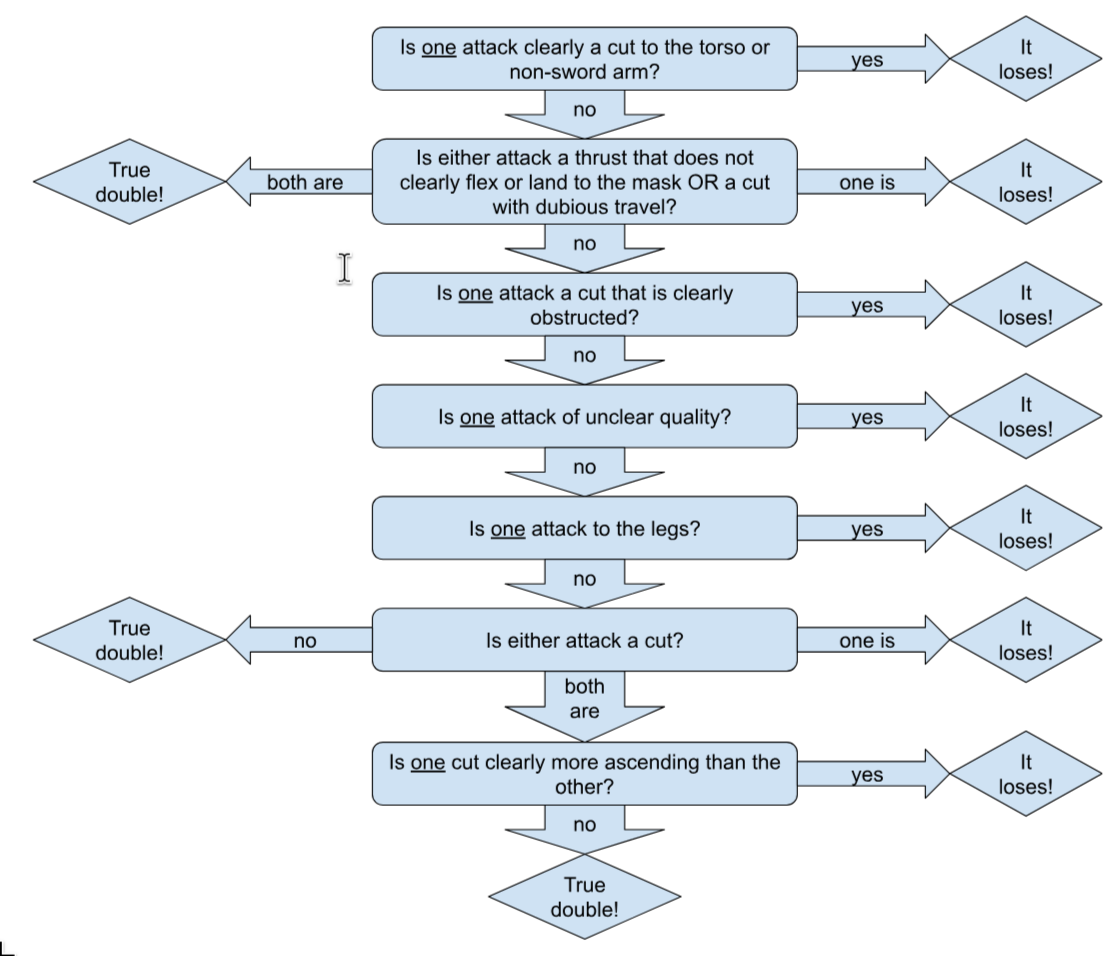
In the case of a double (where the two blows land in the same tempo, AKA the second blow is in motion towards the opponent at the time of the first), the following list is considered. Each item is taken in turn, and if there is any uncertainty from the judges at all about a given item, it is ignored and the next is considered.
- If one blow is a cut which clearly lands to the torso or non-sword arm while the other is not, then it loses priority.
- If there is any disagreement or uncertainty on target, move on to the next question.
Motivation: Purely ideological. We believe that those cuts should always lose priority.
Placement Motivation: Again, purely ideological.
Exploitability: A fencer can simply tank a cut to the torso to purposefully double.
- If exactly one blow is either:
- a thrust which does not clearly flex and did not clearly land to the head
2. A cut which has dubious travel
- a thrust which does not clearly flex and did not clearly land to the head
then it loses priority. If both attacks fit either criteria, the action is ruled a true double.
- This includes both light thrusts and thrusts which glance off.
3. This will necessarily include a large number of head thrusts, as thrusts to the side of the mask oftentimes are unclear and glance off without flexing.
4. If judges are uncertain as to whether or not the thrust flexed, assume it didn’t. Generally, if it does flex, it’s very clear.
5. A cut with dubious travel is any cut where the judges are not completely certain that it had sufficient travel.
Motivation: Excluding the “did that cut/thrust hit arm or torso” question, this sort of thing is the largest source of judging error in rapier. Very often, a thrust that just barely misses is nearly indistinguishable from a thrust that just barely hits, and it can be difficult to exactly judge cut arc, especially during a complex or messy action.
Placement Motivation: This must be highly placed as it is such a significant portion of judge error.
Exploitability: This strongly incentivises thrusts to the torso and shoulder over thrusts to the head. We believe that this provides a significant improvement in safety that outweighs the risk of incentivising fencers to land harder thrusts to make the blade flex, but this does reduce the head’s value as a target.
- If one blow is a cut which is clearly obstructed, then it loses priority.
- Thrusts cannot be obstructed here.
- Given that cuts require a high level of quality, and blasting through the strong or guard is considered non-scoring, a scoring cut that has been obstructed must be through the midblade or the weak.
- This also includes forcing a cut by muscling the arm through the opponent’s blade.
- This also includes an attack which strikes the strong or guard around the same time as, or in unclear time to, landing.
Motivation: An obstructed attack is easily misjudged as barely parried or low quality.
Placement Motivation: This must be highly placed to disincentivize dangerous grugging.
Exploitability: This gives a strong advantage to counterthrusts, which can fail to fully protect from an attack but still win the double.
- If one blow is of unclear quality in any remaining way, then it loses priority.
- This includes the judges disagreeing on quality. If the judges strongly disagree about the quality of an action, and the double gets to this point, the action loses.
Motivation: An unclear attack is obviously easily misjudged.
Placement Motivation: Strong, forceful attacks have a tendency to make the other action unclear. As such, it is necessary for attacks which force their way through the opponent’s arms or blade to have lower priority to avoid grugging.
Exploitability: Strong, forceful, and obvious attacks draw judges’ eyes and make other actions in-time unclear.
- If one blow lands to the legs while the other does not, then it loses priority.
- This includes both cuts and thrusts.
Motivation: Low attacks are much easier for judges to miss.
Placement Motivation: This is placed above cuts > thrusts purely so that thrusts to the leg lose to cuts to higher-priority targets.
Exploitability: Defending the legs is unnecessary when a fencer can just full-send a counterattack and always win.
- If one blow is a cut while the other is a thrust, then it loses priority.
Motivation: Purely ideological, as we believe that the rapier is a thrusting weapon.
Placement Motivation: Not so ideological that it was placed highly, but still ideological.
Exploitability: Thrusting into a cut will win, even if that thrust is suicidal, unprincipled, accidental, or otherwise not a high-quality action.
- If both blows are cuts, and one cut is clearly much more descending than the other, the more ascending cut loses priority.
- This means that rising cuts lose to horizontal cuts, which lose to descending cuts.
Motivation: The more descending a cut, the easier it is to see.
Placement Motivation: It is more likely that a blow is missed due to any of the above criteria than it is to be missed due to being less descending. In addition, it is very easy to remember whether an attack was ascending or descending and so placing this at the end is not harmful.
Exploitability: Not much, honestly. Usually people don’t throw too many rising rapier cuts. Some tournaments even consider rising rapier cuts to be non-scoring, and people don’t even notice.
- If all else fails, the double is a true double and is thrown out.
Motivation: Any judging decision past this point is likely to be totally random and thus actively harmful to consider.
We now have the following flowchart:
The only issue we have encountered thus far with this sort of ruleset is forgetting the flowchart. As such, when judging, it is advisable to have the flowchart printed out.
Results
In our testing, there were relatively few judging errors which were in any way affected by the double/priority system. The vast majority of errors were with thrusts which either barely hit the mask and skipped off or barely missed, and actions which were so totally incomprehensible that all four involved people initially disagreed on what occurred. Doubles and afterblows in general were also rare, as the majority of actions were clean deep thrusts and cuts.
More testing is needed to see how much this ruleset does indeed reduce judging error with any degree of confidence.