Division Rules
Link to original# Our MotivationJudging error is universally hated. As such, reducing its impact and how often it occurs is of significant importance. The vast majority of judging error comes from doubles, where two actions (each of which may or may not be quality) occur at the same time. Judging error in clean hits, either missing hits that were quality, calling hits that didn’t exist or weren’t quality, or mislabeling hits, is both far less common and borderline unsolvable. To reduce the occurrence of judging errors via the ruleset, it is thus beneficial to reduce the number of doubles. While one cannot reduce the number of accidental doubles or unintentional doubles, it is possible to reduce the number of purposeful doubles by offering a superior alternative, which for most tournaments (especially those in Europe) is the afterblow. We have attempted, with this ruleset, to give attempting a parry and then an afterblow a higher expected value than accepting a double. To reduce the impact of judging errors when they do occur in a double or potential double, it is thus beneficial to both reduce the overall impact of a double or overall messy exchange (without reducing impact so much that it becomes beneficial to double to effectively wash a non-beneficial exchange) and ensure that, in general, the action which is more likely to be seen wins a double. Finally, the judge criteria should be as non-detrimental as possible. All judging quality questions in the case of a double must be as clear as possible both in the moment and in recollection (for example, “did one blow control the hands or arms of the opponent” is not easily judgable). All judging quality questions in the case of a double must also not incentivize dangerous actions (for example, “did one blow hit much harder than the other” is not safe). And lastly, all judging quality questions in the case of a double should not be exploitable (for example, “did one blow land to the head while the other did not” is famously exploitable). We believe that we have succeeded in the first two, and somewhat succeeded in the third. # What Is Not Our MotivationThis ruleset does not in any manner, shape, or form attempt to encourage what we view as “artful fencing” or “martial fencing.” No decisions were made based on those criteria. We do not believe that it is productive to try to create a ruleset that incentivizes “artfulness” or “martiality”.# Point System * 5 points: clean hit to a deep target * cut/thrust/slice to head * thrust to torso * dominance in grapple * 3 points: clean hit to shallow target * all other clean actions not worth 5 or 2 points * 2 points: clean hit to legs * cut/thrust/slice to legs * 2 points: double with priority * 0 points: true doubleIllegal actions (any illegal action invalidates any action taken by the penalized fencer, and is added to whatever blow the non-penalized fencer either landed or was forced to pull) All penalties are assigned at the judges’ discretion.* Technical Foul: 2 points to the opponent * Exposing the back of head, or hitting it with culpability * Attacking after the hold * Generic unsafe action (anything that would make the opponent stop fencing) * Yellow Card: 5 points to the opponent * Significant excessive force * Repeated technical fouls * Substantially unsafe actions (reckless closing, leaping attacks, etc) * Red Card: Immediate loss, full points to the opponent * Intentional illegal action * Repeated yellow cards * Severely unsafe and dangerous actions (throws, joint manipulations, etc) * Harming another fencer with significant culpability * Poor behavior, unsportsmanlike conduct * Black Card: Out of the tournament, potentially banned from returning and/or told to leave * Intentional or repeated red cards * Trying to harm another fencer, or successfully harming them with full culpability * Appallingly unsafe and dangerous actions (pommel/guard strikes, punching, etc) * Severely poor behavior, extremely unsportsmanlike conduct * Actual criminal activityIf multiple fencers are penalized simultaneously with technical fouls or yellow cards then the point punishments are done subtractively. So if one fencer gets a technical foul while the other gets a yellow card, the fencer who committed the technical foul gets 3 points. In the case of a clean hit, the winning fencer receives the points for the hit. If the clean hit strikes two targets simultaneously, the higher-value target is taken. If the clean hit clearly strikes one target and then, by bouncing, glancing, or pressing, strikes a second, only the first target is taken. In the case of an afterblow (where the second hit lands in the tempo immediately following the first), the points of each blow are subtracted from the other. The first blow has a minimum of one, the second has a minimum of zero. Afterblows are also held to a far stricter standard of force, meaning that the threshold for excessive force for an afterblow is lower than for an initial hit. If the attack is dubiously an afterblow, be it potentially a double or potentially out of time, it is considered to be an afterblow. Only clear doubles and clear two-tempo actions, including both feints and actions requiring multiple steps, are not afterblows. If the arm must substantially pull back before extending again, this is out of time and not an afterblow. If a fencer lands both a double and an afterblow, then only the double is scored.
| Scores are: (fencer one, fencer two) | Fencer Two (hits second) | |||
|---|---|---|---|---|
| 5 point target | 3 point target | 2 point target | ||
| Fencer One (hits first) | 5 point target | (1,0) | (2,0) | (3,0) |
| 3 point target | (1,2) | (1,0) | (1,0) | |
| 2 point target | (1,3) | (1,1) | (1,0) | |
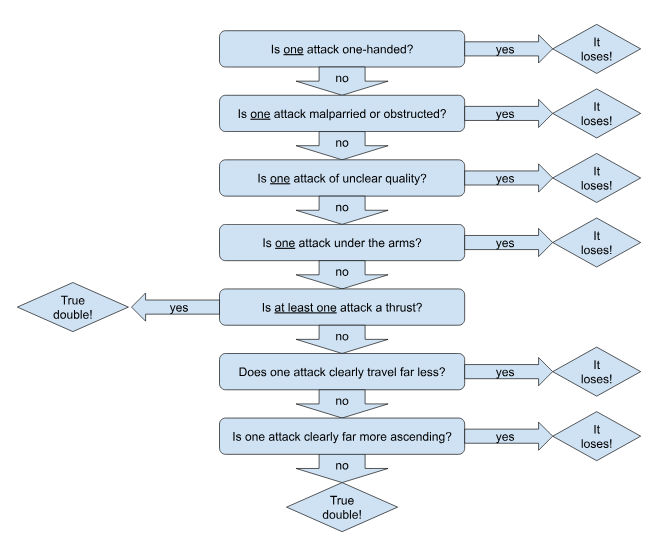 The only issue we have encountered thus far with this ruleset is forgetting the flowchart. As such, when judging, it is advisable to have the flowchart printed out.# # ResultsIn experimentation, where judge calls were corrected by the fencers, the average judging error impact was calculated.If the fencers strongly disagreed with the judge’s call, then the error was logged as having the impact of the point differential with what the fencers believed was the correct call. So if the call had a 1-0 score, but the correct call would have been 0-3, that is a four point differential. Similarly, if the call had a 2-1 score but the correct call would have been 2-0, that is a one point differential. If the fencers were unsure, then all potential differentials for all potentially correct calls were weighted evenly and averaged together. So if the call had a 2-0 score but the fencers were unsure whether it was a 2-0, a 3-0, or a 0-3, then the differential would be the average of 0, 1, and 5, and thus would be 2. “Unjudgable” incorrect calls – specifically calls where all vision of an action was blocked due to fencer rotation and actions which struck the grip of the longsword but were called as hand hits – were thrown out. The average point differential from an incorrect call was approximately 1.8, with a standard deviation of approximately 0.4. This is due to over three-quarters of incorrect calls having a one point differential, with the most common errors being between 2-0 doubles and 3-0 clean shallow hits, 2-0 doubles and 1-0 equal-target afterblows, and 0-2 doubles and 1-2 shallow-deep afterblows. This is, in our opinion, a very good average impact for judge error, as one clean deep hit is worth more than two and a half average judge errors and a single double is worth more than one average judge error.However, it must be noted that this judging error average impact was computed from the errors made by a single judge over a series of too-few individual matches including too-few distinct fencers. As such, it must be taken with a grain of salt until more testing is done.